Reflections on the KZN Art Fair as a developmental proposition: a response to Heidi Thembeka Sincuba
POSTED ON: November 9, 2026 IN ASAI, Biennials, Fairs, Mega-exhibits & Curators, Mario Pissarra, Opinion, Reviews & Reports, Word View, Word View AuthorsBy Mario Pissarra
KwaZulu-Natal (KZN) is a generative space that has contributed much to South African art. But it has always been a comparatively small scene, with many of its artists and curators leaving for greener pastures. Awareness of that duality feeds a favorite local topic – the visual arts ecosystem. There are a fair number of actors in that system – in varying states of health – with the limited art market a perennial point of concern. For artists to exhibit there are a few options, formal and informal. But to exhibit and sell, well, that is asking a lot. Chances are you’re better off with an agent or gallery elsewhere, or you could consider feeding commercially established tropes of Africa to the art boutiques in Umhlanga and Ballito. For most gallerists, a picture framing course is a wise investment.
Within this environment, the KwaZulu-Natal Society of Arts (KZNSA) has been an anchor for over a century, although its moorings as a non-profit have not always been stable. Situated in Durban, the hub of KZN, its contemporary form illustrates that galleries survive through mixed-means. Art sales are just one ingredient in a pot that includes erratic grants and sponsorship, income from an in-house café and shop, and, crucially, community support in the form of an active membership. Most of us working in the visual arts in Durban are either members of the KZNSA or engage in one way or another. Similarly, KZNSA’s prominent members tend to be involved in the activities of other entities. In KZN, collaboration is not an idea, it is a necessity.
Art fairs have come to play a pivotal role in ensuring the financial viability of South African galleries. For the big players, most of this business is international, although fairs in Johannesburg and Cape Town are important events on the local calendar, even if primarily to remind competitors who rules the roost. KZN-based galleries are seldom present at these events – most cannot afford the rates, never mind the associated costs of getting and being there. The KZNSA has been the one entity in the province that has most actively pursued representation at fairs, commencing with its debut at Latitudes in 2019. Along the way it has faced some obstacles. I recall my shock in 2022 when its application was declined by FNB Art Joburg. This was at a time that it was fighting to keep its doors open, the eThekwini municipality having reneged on a three-year grant award. Declining their application, more so in their hour of need, suggested either ignorance or worse. Surely the big fish could not be so callous towards one of the sources of their own feed? That same year the Investec Cape Town Art Fair (ICTAF) cancelled its Cultural Platform section, ostensibly a developmental initiative to support non-profits, after organisations objected to its ill-conceived idea that they were not allowed to sell art, only ‘promote’ themselves…
This background is sketched to explain why, as KZN-based visual arts organisations, we welcomed the launch of the KZN Art Fair (KZNAF). We had also supported its precursor, the Durban Art Fair, but were not surprised when it crashed before take-off, given the declining support by the eThekwini municipality for the visual arts. The new partnership with the Hilton Arts Festival – an established event with underdeveloped representation from the visual arts – seemed a pragmatic option, more especially since the KZNAF has yet to attract significant financial backing or sponsorship and needs to minimise the costs that a standalone event requires.
Within this context, Heidi Sincuba’s charge that the inaugural KZNAF misrepresented its true identity as a transactional entity by masquerading as a transformative project went down like the neighbour’s cat peeing on your new carpet — at least for those who chat constantly about the ecosystem and view the establishment of the KZNAF as an important step towards developing a sustainable art economy in KZN.
It’s hard to not read Sincuba’s negative account of the Fair as having stemmed from a grievance. Having secured a free press pass (for the Mail & Guardian), she switched back into her role as a lecturer at the Durban University of Technology (DUT), asking for complementary passes or a group discount for her students. When this was declined, Sincuba opted to pay the R50 student fees to ensure their attendance. This episode “told [her] almost everything [she] needed to know about the Fair.” According to Sincuba, the event failed to be “cultural development” by treating her students as consumers, rather than viewing them as prospective actors in the art world. This experience led to her damning assailment of the developmental integrity of the KZNAF, claiming that “Its crude objective appears to be money”. One can only wonder if the promotional language used by the Fair would have irked her as much if her students had been given free access.
In their right of reply, the KZN Art Fair’s directors pointed out that, by contrast, University of KwaZulu-Natal (UKZN) students attended the Fair with financial aid from their institution, and that Sincuba had access to equivalent support from DUT, which she appears to have not requested. Whether Sincuba was ethically correct to expect a start-up Fair to absorb costs she had institutional access to is worth asking. But perhaps the more important question is whether it is possible to conceive of art fairs as more than commercial events? Indeed, can they be framed as developmental? And if so, is it correct to elevate the question of access for economically challenged students to be the primary indicator of the developmental integrity of an art fair?
It is common purpose, as Sincuba notes, that the very idea of an art fair is a commercial proposition. She states that she has no truck with it being so; in fact, she will support it if it proclaims this goal. However, through her emphasis on the question of access for students from economically challenged communities she appears to hold credence that it can be more than that.
Not being one who has ever written in support of an art fair before, I hazard that for someone to make transformative or developmental claims for an established fair, these would probably centre on boosting tourism and/or introducing new entrants into the economy, particularly those historically excluded. The notion of ‘audience development’ is also likely to be dropped in somewhere. In the South African context, these claims would translate into working towards normalising galleries as black-owned, growing the number of black collectors, and having an audience that, at least superficially, mirrors the national demographic. If such a project were to succeed, the profile of actors and audiences would change, although in all probability the template of the fair as an elite transactional space for capital would be retained.
But what when a fair is launched in an art environment where markets are not well established and the entire ecosystem is fragile? Can and should we expect more? If so, how should we measure the success of its inaugural event and, perhaps more importantly, gauge its developmental integrity?
In attempting to answer these questions it is worth considering Sincuba’s pertinent question whether the vision of the KZNAF is to mimic the established South African art fairs and assimilate into their network; or develop something unique that addresses local needs. For Sincuba it is clear that the Fair is not responding adequately to its challenge as a KZN-based initiative, the evidence being the apparent exclusion of her students. If not different then, then the typical measure should apply: how many major galleries participated, and did they make money? If we take that approach, it would appear that the KZN Art Fair barely got out the starting blocks.
However, I would argue that dismissing the inaugural event on the above grounds fails to take account of its achievements. First, let’s clarify its vision. Signs suggest that the Fair’s directors are attempting a balancing act. On one hand they are clearly conforming to industry standards – look, for example, at the clinical presentation of booths and the custom of fostering exclusivity through a VIP opening. Conversely, note the opening of doors to a number of locally-based entities and constituencies for whom the established fairs are at best destinations to visit. Indeed, contrary to the misleading advice in the title of Sincuba’s text – “don’t ask for a seat at the table” – there is ample evidence that deliberate efforts were made to ensure participation from the varied kinds of entities that comprise the ecosystem – not only galleries and auction houses, but also education institutions, publishers, bookstores, non-profits, artist-led projects and independent curators. No surprise then that one theme surfaced consistently throughout the education programme – that damn ecosystem again.
It would be unfair to hold Sincuba responsible for the absence of DUT at the KZNAF, but certainly her foregrounding of her students as a key constituency begs the question: who should be prioritised at the ‘table’ at this point in the establishing of the Fair: students or their institutions? Surely, she would not disagree that an emphasis on growing a network or ecosystem should apply a strategic focus in attracting a diversity of formal and informal entities who will in turn enable the presence and participation of their constituents?
The intent to privilege ‘structures’ can also be read into the organisers’ approach to artists, encouraging them to apply as collectives. We can see this as a pragmatic means to address the reality that most artists are not represented by galleries, as well as that it was unlikely that an inaugural fair (more so one in KZN) would be flooded with applications from galleries. But we can also see this as a developmental strategy, encouraging artists to work together. A slightly different approach was applied for independent curators – they were encouraged to present ideas for curated booths. These were innovative approaches, specific to the conditions in which the Fair has emerged.
It was this spirit of inclusion which, I believe, explains why the exhibitors I spoke to were positive about their experience of the Fair, notwithstanding that several probably did not break even (a risk that exhibitors take, even with established fairs). For many among the local cohort, the success of the event was in feeling part of an event that is in the making. Notwithstanding the legal identity of the fair as a private venture — this is our fair. Not ours in an exclusive, parochial sense, but ours in that we share a sense of common purpose.
All of this runs contrary to Sincuba’s narrative. She sees no integrity or imagination at play. For her the location of the Fair in an exclusive area negates it’s claims to be developmental. As a journalist, she pays no mind to the hard road to Hilton – three years of thankless negotiations with the city of eThekwini and the national department of Sport, Arts and Culture, followed by being welcomed in the Midlands. Instead, she implies that the organisers took the easy option: “After the apparent failure of the Durban Art Fair, staged in the thick of the City, the KZN Art Fair relocated more than an hour away to Hilton College, piggybacking on the established Hilton Arts Festival.” Her use of the word “staged” suggest that she thinks the Durban Art Fair happened – it didn’t, or rather it couldn’t. Then, while damning the project for its elite location, she offers no alternate suggestions. Nor does she appear to consider that a fair could, at least in part, act to support the sustainability of the sector, not least those who do work in a more obviously developmental manner. And before we get carried away with ideas of rather being “in the thick of the city”, wherever that may be, let’s not forget the hard truth that the visual arts have a long way to go to establish itself as a popular activity. That is the slow work being done by some of us in the ecosystem, including several exhibitors at the KZNAF. Indeed, even in the hallowed halls of Hilton, most of the festival goers were there for theatre and music, not the visual arts.


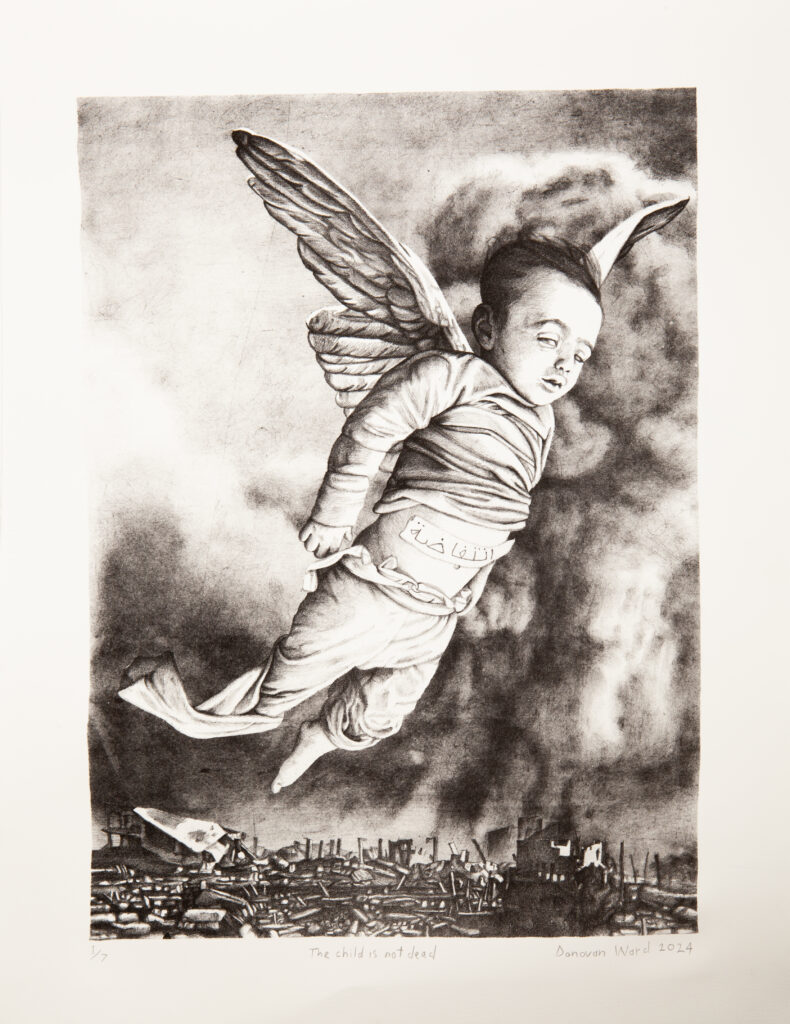
Sincuba fails to situate the Fair in its actual context. She opts to belittle the inaugural event as “two thinly dressed exhibition halls of mostly mediocre art”. The exceptions? Well the only artists she is excited enough to mention are market darlings — Pierneef and Kentridge. She does not see what is growing. She does not see or draw attention to the work of young artists such as Zama Mwandla (KZNSA) and Alka Dass (Art-ists Collective and Kulture Imbizo Projects). Nor does she see Manfred Zylla’s acerbic response to German militarism, Donovan Ward’s poignant adaption of Ingrid Jonker’s “The child is not dead” to the genocide in Gaza, and the last relief print made by the late Thami Jali (all exhibited by ASAI); nor Kim Berman’s devastated landscapes (Artist Proof Studios). Nor does she, as an art historian, appear to appreciate the revisionist significance of historical tapestries and ceramics from Rorke’s Drift (Riaan Bolt Antiques), or the significance of having Clarke’s Bookshop as an exhibitor in a province where the few decent bookstores are second hand. And for someone who wants to break down walls, we don’t know what she thought of an art fair exhibiting design and craft coming from the province. The entities she finds worth naming? Strauss and Co., the Candice Berman Gallery, and (the only one not in an established category) Studio Sunday Best.
No doubt about it, the event was modest, with just over 20 exhibitors, but let’s look at the inaugural edition’s success in securing half the exhibitors from other provinces. Let’s applaud the Fair’s directors for their holistic vision of the ecosystem, their tenacity in overcoming a multitude of hurdles, their courage in taking risks in embarking on this project, and their imagination in curating a Fair in an environment that is more accustomed to Art in the Park. Not least, for putting the event together with limited financial support, in what must have been a heavily pressured six months.
Certainly, it is too early to tell whether the Fair will succeed in sustaining a balance between being same and other; alternately whether it will go the way of the established fairs with the locals having little access as exhibitors, or lapse into a provincial affair ignored by the main industry players. Or fail entirely. For now, let’s see who comes back next year and who the new exhibitors will be. Let’s see whether the first iteration demonstrated enough potential to convince local government and corporates to come to the party. And let’s see what we can do to help it grow.
Sincuba’s cavalier commentary on the KZNAF was ill-considered and untimely. We do need robust criticism of the art industry, its exploitative practices and elitism, but why pick on the smallest kid in the class? That said, we can also look at her critique in a more positive light, to consider the extent to which an economic project such as an art fair can embody or support developmental objectives, and to remind us, while the fair grows and establishes itself, to not lose sight of the principle of access.
Mario Pissarra attended the KZN Art Fair as an exhibitor and panelist, in his capacity as director of the Africa South Art Initiative and editor of On the Map (ASAI, 2026). ASAI is a non-profit company based at DUT and UCT.
References
Heidi Sincuba “The KZN Art Fair just wants your money just don’t ask them for a seat at the table”. Mail & Guardian
KZN Art Fair Management “KZN Art Fair: Right of Reply”
Share


